Does LED Light Therapy Really Reduce Perioral Wrinkles? What the Clinical Data Shows
Most consumer LED devices rely on self-reported surveys to substantiate their claims. Metamorphosis goes further. Independent biometric clinical studies using gold-standard instruments — including the AEVA3D-HE2, Cutometer, and Mexameter —...


The short answer: Yes — when substantiated by independent biometric clinical measurement, LED light therapy produces statistically meaningful reductions in perioral wrinkle depth and improved skin elasticity. Independent studies using professional instruments including the Cutometer, AEVA3D-HE2, and Mexameter confirm that photobiomodulation at targeted wavelengths drives measurable cellular-level changes in aging lip-area skin — not just self-reported improvement, but instrument-verified results.
If you’ve searched for solutions to lip-line wrinkles — the fine lines that form above and around the lips as we age — you’ve likely encountered a marketplace full of claims and very little science. Retinol creams. Filler. Laser resurfacing. And increasingly, LED light therapy devices. But how do you separate genuine clinical efficacy from marketing language?
At Metamorphosis Light Therapy, we believe the answer lies in the data — specifically, the kind of biometric instrumental data that most consumer beauty brands never generate. Here’s what the science actually shows.
What causes perioral wrinkles — and why they’re notoriously difficult to treat
Perioral wrinkles — the lines that radiate outward from the lip border — develop from a combination of collagen and elastin breakdown, repeated muscular movement (particularly from speaking and expressions), UV exposure, and the progressive thinning of skin that accompanies natural aging. The perioral area is uniquely challenging because:
• The skin is thinner than most facial zones and receives less sebaceous support
• Constant muscular activity prevents skin from fully resting between contractions
• Traditional topical treatments penetrate poorly due to the area’s unique anatomy
This is precisely why photobiomodulation — the mechanism behind LED light therapy — is scientifically compelling for this specific indication. Rather than acting on the surface, it works at the mitochondrial level inside the skin cell.
What is photobiomodulation and how does it work on aging skin?
Photobiomodulation (PBM) is the use of specific wavelengths of light — typically in the red (630–700nm) and near-infrared (700–1100nm) spectrum — to stimulate biological processes within skin cells. The mechanism is not heat-based; it is photochemical.
When red light photons penetrate the dermis, they are absorbed by cytochrome c oxidase — a key enzyme in the mitochondrial electron transport chain. This absorption triggers a cascade of cellular responses:
• Increased ATP (adenosine triphosphate) production, the energy currency that powers cellular repair
• Upregulation of collagen and elastin synthesis in dermal fibroblasts
• Reduction in inflammatory cytokines that accelerate skin aging
• Improved microcirculation supporting nutrient delivery to skin tissue
In the context of perioral wrinkles, this means PBM targets the root cause — collagen degradation and diminished cellular energy — rather than masking the symptom.
How Metamorphosis clinically validated LushLips Transformation
Most consumer LED devices are substantiated by self-reported surveys — asking users whether they feel their skin looks better. We chose a different standard.
Metamorphosis commissioned independent biometric clinical studies through Laboratorio Goya (Dr. Goya Análisis, Spain), a professional cosmetic testing laboratory. These studies used gold-standard instrumental measurement tools to generate objective, quantifiable data — the same category of instrumentation used in pharmaceutical and dermatological research.
|
Instrument |
What it measures |
Why it matters for perioral skin |
|
AEVA3D-HE2 |
3D wrinkle depth and surface topography |
Quantifies actual wrinkle reduction vs. placebo or baseline |
|
Cutometer® |
Skin elasticity and firmness (mechanical properties) |
Measures the collagen-driven structural improvements PBM stimulates |
|
Corneometer® |
Skin hydration levels |
Confirms barrier function and moisture retention changes |
|
Mexameter® |
Melanin and erythema (redness) |
Tracks evenness of skin tone around the lip area |
|
Glossymeter® |
Skin surface gloss and texture smoothness |
Objective measurement of surface texture improvement |
This is not common in the consumer LED device category. The use of 3D topographic imaging and mechanical elasticity measurement to substantiate an at-home skincare device represents a clinical standard typically reserved for pharmaceutical and professional dermatological products.
What does FDA 510(k) clearance mean for a consumer LED device?
FDA 510(k) clearance is a premarket submission process demonstrating that a medical device is substantially equivalent to a legally marketed predicate device in terms of intended use and technological characteristics. It is not a cosmetic claim — it is a regulatory determination.
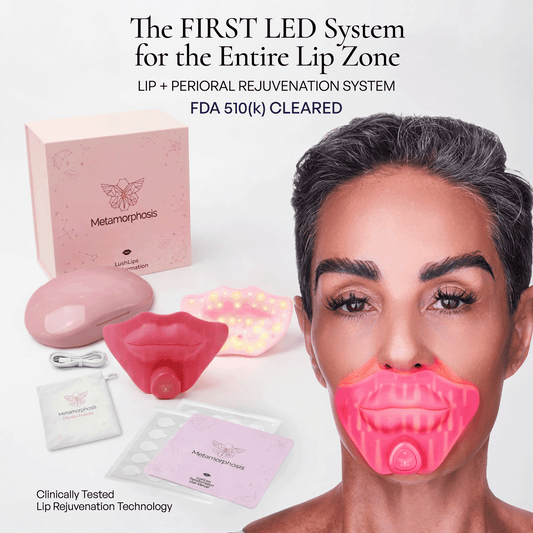
LushLips Transformation holds FDA 510(k) clearance specifically for the treatment of perioral wrinkles. This means:
• The device has been reviewed against established safety and performance standards
• Its intended use claim (perioral wrinkle treatment) has regulatory standing
• It is legally marketed as a medical device, not merely a beauty gadget
In a market where the vast majority of consumer LED devices carry no FDA clearance for specific indications, this distinction is material for the consumer making a purchasing decision.
How is LED therapy for perioral wrinkles different from other at-home treatments?
The perioral wrinkle treatment market is crowded with options. Here is how photobiomodulation compares on the dimensions that matter for long-term results:
|
Treatment |
Mechanism |
Downtime |
Clinical Evidence |
|
LED light therapy (PBM) |
Mitochondrial stimulation, collagen synthesis |
None |
Biometric instrument studies; FDA clearance |
|
Retinol creams |
Cell turnover acceleration |
Possible irritation |
Variable; often self-reported |
|
Injectable filler |
Physical volume replacement |
Minimal–moderate |
Clinical; temporary result |
|
Laser resurfacing |
Controlled skin injury / regeneration |
Significant |
Clinical; practitioner-only |
|
Microneedling |
Collagen induction via micro-injury |
Moderate |
Clinical; practitioner-only |
The bottom line
LED light therapy for perioral wrinkles is not a trend — it is a scientifically grounded modality substantiated by peer-reviewed photobiomodulation research and, in the case of LushLips Transformation, by independent biometric clinical measurement using the same instruments deployed in pharmaceutical skincare research.
Metamorphosis Light Therapy was built on one premise: the science should speak louder than the marketing. Our clinical data exists because we believe you deserve to know — with measurable certainty — whether a device works.
Metamorphosis doesn’t follow beauty trends. It follows the science.
Explore LushLips Transformation →