Is Red Light Therapy a Real Alternative to Lip Fillers? Here’s What the Science Actually Says
Lip fillers cost $500–$1,000 per session and last 6–12 months. LushLips Transformation is FDA 510(k)-cleared, independently clinically studied for 84 days, and produced a 42–46% reduction in perioral wrinkle density....

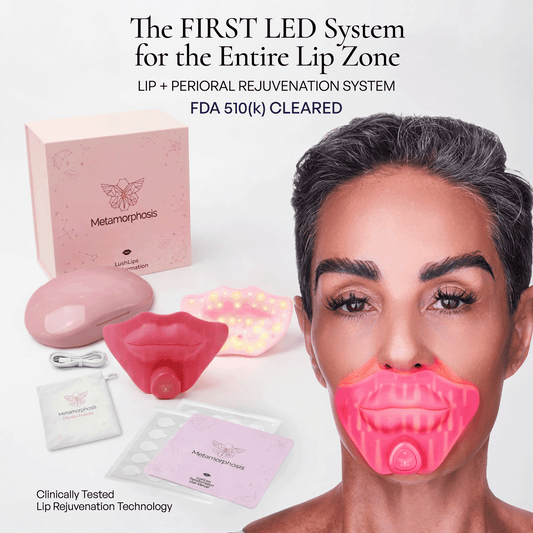
The direct answer: Red light therapy and lip fillers work through fundamentally different biological mechanisms and are not direct substitutes for each other — but that framing misses the more important question. For the millions of people seeking meaningful, non-invasive improvement in lip lines, perioral wrinkling, and lip contour without the cost, recovery, or risk of injectables, the clinical evidence for red light therapy is far stronger than most people realize. An independent 84-day biometric clinical study found that LushLips Transformation by Metamorphosis Light Therapy — FDA 510(k)-cleared for perioral wrinkle reduction (K213024) — produced a 42–46% reduction in wrinkle density, a 17–23% improvement in firmness and elasticity, and measurable increases in lip volume, all confirmed by validated dermatological instrumentation. Harper’s Bazaar named LushLips one of the 6 Best Red Light Therapy Devices for Lips. Shape awarded it Best in Skin for 2025. CosmoProf awarded it Overall Winner in Skin and Body Care Products in 2024. Good Morning America featured it alongside board-certified dermatologist Dr. Dendy Engelman. The question is not whether red light therapy works for lips. The question is whether it is right for you — and this post will help you answer that honestly.
The State of the Question in 2026
Red light therapy is having a mainstream moment. NPR, Stanford dermatologists, and beauty editors are all weighing in on whether photobiomodulation devices actually deliver on their promises — or whether the category is overrun with unsubstantiated claims. It is a fair question, and it deserves a fair answer grounded in clinical data rather than marketing language.
At the same time, the injectable aesthetics market continues to grow. Lip fillers remain one of the most popular cosmetic procedures in the United States, with millions of treatments performed annually. For many people, fillers deliver the volume and line correction they are looking for — but at a cost that repeats every 6 to 12 months, with side effects that include bruising, swelling, and the risk of unnatural results.
The question being asked by a growing segment of consumers is not “fillers or nothing.” It is: “Is there a clinically substantiated non-invasive option that delivers real, measurable improvement — and what does the science actually say?” That is the question this post answers.
How Lip Fillers Work: The Mechanism
Hyaluronic acid lip fillers — the most widely used category — work by physically adding volume beneath the skin surface through injection of a gel-like substance. The results are immediate and primarily mechanical: the filler occupies space, pushing the skin outward and smoothing the appearance of lines from below.
The benefits of hyaluronic acid fillers include:
• Immediate visible volume increase
• Predictable, reproducible results under an experienced injector
• Reversibility with hyaluronidase enzyme if results are unsatisfactory
The limitations include:
• Cost of $500–$1,000 per session, repeated every 6–12 months
• Common side effects including bruising, swelling, tenderness, and asymmetry
• No improvement in underlying skin biology — the skin itself does not become firmer, more hydrated, or more elastic as a result of filler
• Gradual metabolization requiring retreatment to maintain results
• Risk of vascular occlusion, migration, and overfilled appearance with cumulative use
How Red Light Therapy Works: A Different Mechanism Entirely
Red light therapy via photobiomodulation does not add volume through injection. It works at the mitochondrial level to stimulate the biological processes the skin uses to build and maintain its own structure.
The primary target is cytochrome c oxidase — a photoreceptor enzyme in the mitochondrial electron transport chain. When red light wavelengths are absorbed by this enzyme, ATP production increases, driving cellular processes including:
• Fibroblast activation — stimulating the cells responsible for producing new collagen and elastin in the dermis
• Collagen Type I and III synthesis — rebuilding the structural proteins responsible for skin firmness and lip contour
• Enhanced microcirculation — improving blood flow and nutrient delivery to perioral tissue
• Reduced inflammatory cytokines — decreasing the chronic low-grade inflammation that accelerates perioral aging
The result is not immediate mechanical volume. It is progressive structural improvement — the skin becomes genuinely firmer, more elastic, better hydrated, and more luminous over time because the underlying biology is being supported, not bypassed.
The LushLips Clinical Data: What 84 Days of Biometric Testing Showed
LushLips Transformation was evaluated in an independent 84-day clinical study.
The results across 30 participants over 84 days using validated biometric instrumentation:
Wrinkle Reduction (AEVA3D-HE2 3D Imaging)
• 42–46% reduction in perioral wrinkle density — statistically significant
• Up to -44% median wrinkle density reduction confirmed by 3D surface imaging
• 83% of participants showed visible improvement confirmed by independent dermatologist evaluation
Firmness & Elasticity (Cutometer®)
• 17–23% statistically significant gains in skin firmness and elasticity
• 84% of consumers reported feeling tighter, firmer skin
Lip Volume & Contour (AEVA3D Volumetric Imaging)
• Measurable increase in lower lip volume confirmed by 3D volumetric imaging
• 87% showed enhanced lip contour and definition confirmed by dermatologist grading
• 85% of consumers reported lips looked plumper and smoother
Safety
• 94% reported no adverse effects
• No serious adverse events reported across 84 days of dermatologist-monitored testing
An Honest Side-by-Side Comparison
Rather than oversell red light therapy or dismiss fillers, here is an honest clinical comparison of both options for perioral aging:
Mechanism:
Lip Fillers — Mechanical volume via injection. Red Light Therapy — Cellular stimulation via photobiomodulation.
Speed of results:
Lip Fillers — Immediate. Red Light Therapy — Progressive; measurable improvement by Day 28, significant results by Day 84.
Wrinkle reduction:
Lip Fillers — Significant for deeper lines via volume displacement. Red Light Therapy — 42–46% reduction in perioral wrinkle density confirmed by AEVA3D biometric imaging.
Skin biology improvement:
Lip Fillers — None; the skin itself does not change. Red Light Therapy — Yes; firmness, elasticity, hydration, and radiance all improve instrumentally.
Cost:
Lip Fillers — $500–$1,000 per session, every 6–12 months. Red Light Therapy — One-time device investment, no recurring treatment cost.
Side effects:
Lip Fillers — Bruising, swelling, tenderness, asymmetry risk. Red Light Therapy — 94% reported no adverse effects in clinical study.
FDA status:
Lip Fillers — FDA approved as medical device. Red Light Therapy (LushLips) — FDA 510(k)-cleared for perioral wrinkle reduction.
Reversibility:
Lip Fillers — Reversible with hyaluronidase. Red Light Therapy — Non-invasive; no reversal needed.
Can Red Light Therapy Be Used Alongside Fillers?
Yes — and for many people, this is actually the most clinically compelling use case. Board-certified dermatologist Kunal Malik of Mount Sinai Hospital has noted that red light therapy may actually help maintain filler longevity by supporting collagen production — meaning the underlying skin structure becomes stronger, potentially extending the duration of injectable results.
The general clinical guidance for using red light therapy after lip filler injections is to wait at least 48 hours post-injection before beginning treatment, and to consult with your injector. Beyond that window, red light therapy’s anti-inflammatory and collagen-stimulating effects are complementary to, not competitive with, the structural work that fillers perform.
For those who use fillers periodically and want to reduce the frequency of retreatment — or extend the visible results between sessions — a consistent red light therapy protocol with LushLips represents a clinically substantiated strategy for doing exactly that.
Who Red Light Therapy Is Right For
Based on the clinical evidence, LushLips Transformation is particularly well suited for:
• Adults seeking meaningful, non-invasive improvement in perioral wrinkling and lip contour without the cost or side effects of injectables
• Those who have tried topical treatments without achieving satisfactory results in the perioral zone
• Filler users who want to extend results between sessions and improve underlying skin biology
• Anyone who wants a clinical-grade intervention validated by an independent 84-day study with biometric instrumentation — not a 28-day cosmetic trial with self-reported outcomes
• Those who want the confidence of FDA 510(k) clearance for wrinkle reduction — which the vast majority of LED beauty devices on the market do not hold
Independent Validation: What the Industry Has Said
The clinical data on LushLips Transformation has been independently validated not only by a research laboratory — but by the most credible editorial, professional, and clinical voices in the beauty industry:
• Harper’s Bazaar — Named LushLips one of the 6 Best Red Light Therapy Devices for Lips, entirely unsolicited and editorial
• Shape Magazine — 2025 Award for Skin
• CosmoProf — Overall Winner, Skin and Body Care Products division, 2024
• Good Morning America — Featured alongside board-certified dermatologist Dr. Dendy Engelman
The Bottom Line
Red light therapy is not a replacement for lip fillers in the way that fillers are not a replacement for red light therapy. They work differently, address different aspects of perioral aging, and can work together effectively.
What red light therapy with LushLips Transformation does offer — backed by 84 days of independent biometric clinical data — is a 42–46% reduction in perioral wrinkle density, 17–23% improvement in firmness and elasticity, measurable lip volume increase, and zero serious adverse events. FDA cleared. Independently studied. Recognized by the industry’s most credible voices.
For anyone asking whether the science is real: it is. And it is available now at metamorphosislighttherapy.com.
Metamorphosis doesn’t follow beauty trends. It follows the science.
About the Author
Sally Gardocki, Esquire is the CEO and Founder of Metamorphosis Light Therapy, LLC — a Charleston, SC-based clinical beauty technology company built on photobiomodulation science. Metamorphosis devices are substantiated by independent 84-day biometric clinical studies. The company holds multiple FDA 510(k) clearances and nine provisional utility patents filed in 2026.