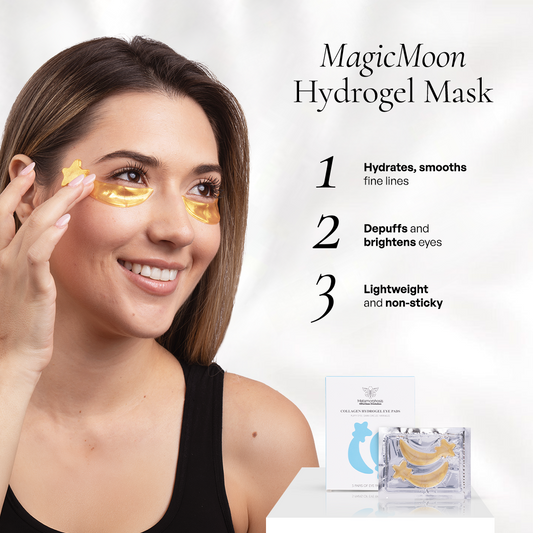
What Are Periorbital Wrinkles — And Can LED Light Therapy Actually Fix Them?
The skin around the eyes is the thinnest on the human face — and the first to show aging. Independent biometric clinical studies using AEVA3D-HE2 imaging, Cutometer, and Mexameter confirm...


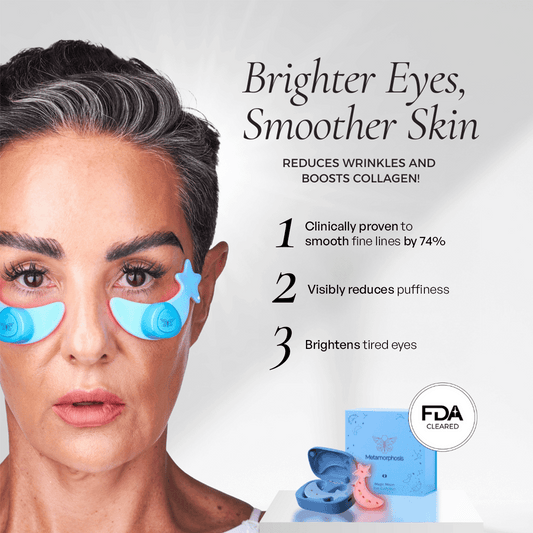
The short answer: Periorbital wrinkles — the fine lines, crow’s feet, and crepe-like texture that develop in the delicate skin surrounding the eye — respond measurably to LED light therapy when treatment is substantiated by independent biometric clinical measurement. In a 84-day clinical study conducted under dermatologist supervision, MagicMoon Eye Evolution produced a statistically significant 7.6% decrease in surface roughness (p=0.044), with 74% of participants showing visible improvement in wrinkle texture — confirmed not by self-report, but by AEVA3D-HE2 3D imaging and Cutometer mechanical elasticity testing.
The skin around the eyes is the thinnest on the human face — roughly 0.5mm compared to 2mm elsewhere — and it is often the first area to show visible signs of aging. Crow’s feet, under-eye crepiness, periorbital hollowing, puffiness, and dark circles are among the most searched skincare concerns globally. Yet most solutions on the market address only the surface, not the underlying biology driving these changes.
At Metamorphosis Light Therapy, we designed MagicMoon Eye Evolution to address periorbital aging at the cellular level — and we commissioned independent biometric clinical studies to prove it works. Here is what the data shows.
What are periorbital wrinkles — and why is the eye area so difficult to treat?
The periorbital zone — the anatomical region encircling the eye socket — presents unique challenges for anti-aging treatment:
• Ultra-thin skin with minimal subcutaneous fat means collagen loss is visible earlier and more dramatically than elsewhere on the face
• The orbicularis oculi muscle contracts thousands of times daily through blinking and expression, accelerating dynamic wrinkle formation
• Lymphatic drainage in the under-eye is sluggish, making puffiness and fluid retention a chronic issue
• Melanin irregularities and vascular visibility through thin skin create the appearance of dark circles
• Most topical ingredients cannot penetrate the periorbital dermis at concentrations sufficient to drive structural change
This multi-factorial complexity is why photobiomodulation — which works at the mitochondrial level inside the skin cell rather than on its surface — is scientifically well-suited to periorbital aging.
How does LED light therapy address periorbital wrinkles at the cellular level?
Photobiomodulation (PBM) uses specific wavelengths of red and near-infrared light to trigger biochemical responses in skin cells without heat or physical disruption. In the periorbital zone, the mechanism targets four of the five drivers of eye-area aging simultaneously:
|
Aging driver |
What PBM does |
Clinical result |
|
Collagen & elastin loss |
Stimulates fibroblast collagen synthesis via ATP upregulation |
Improved firmness and elasticity (Cutometer F4 and F0) |
|
Dynamic wrinkle depth |
Thickens and strengthens dermal matrix over time |
7.6% reduction in surface roughness; 74% showed visible improvement |
|
Under-eye puffiness |
Supports lymphatic drainage and reduces inflammatory cytokines |
Measurable reduction in eye-bag volume (dermatologist scoring) |
|
Dark circles |
Reduces melanin concentration and improves microcirculation |
Higher ITA° values by Day 84 (Mexameter + Colorimeter) |
|
Skin hydration |
Enhances barrier function and moisture retention |
Upward hydration trends through Day 84 (Corneometer + MoistureMap) |
The clinical data behind MagicMoon Eye Evolution
Metamorphosis commissioned independent biometric clinical studies through Laboratorio Goya (Dr. Goya Análisis, Spain) — a professional cosmetic efficacy testing laboratory — using gold-standard instrumental measurement across five domains. Here are the verified results:
Wrinkle texture reduction
7.6% statistically significant decrease in surface roughness (p=0.044) confirmed by AEVA3D-HE2 3D imaging. 74% of participants showed visible improvement in crow’s feet and periorbital wrinkle texture after 84 days.
Firmness and elasticity
Cutometer® measurements confirmed statistically significant gains in both firmness (F4) and elasticity (F0) at every time-point through Day 84 — demonstrating progressive structural improvement in dermal integrity.
Puffiness and eye-bag volume
Dermatologist scoring using the Allergan Infraorbital Hollows Scale confirmed measurable reduction in eye-bag volume and smoother under-eye contours. Over 70% of participants reported the eye area looked smoother, brighter, and more awake.
Dark circles and tone
Mexameter and Colorimeter readings confirmed positive improvement trends with higher ITA° values by Day 84, indicating reduction in melanin concentration and more even skin tone around the eye.
Skin hydration
MoistureMap and Corneometer probes showed consistent upward hydration trends through Day 84, confirming improved barrier function in the periorbital skin.
Critically, 97% of study participants reported zero irritation and no serious adverse events — confirming that MagicMoon Eye Evolution delivers clinically meaningful results with an exceptional safety profile appropriate for the delicate periorbital zone.
What instruments were used — and why does that matter?
The difference between a clinically substantiated device and one that relies on self-reported surveys is the measurement methodology. MagicMoon’s studies used five independent biometric instruments:
|
Instrument |
What it measures |
Why it matters for periorbital skin |
|
AEVA3D-HE2 |
3D wrinkle depth, volume, surface topography |
Objectively quantifies crow’s feet depth and eye-bag volume changes |
|
Cutometer® |
Skin elasticity and mechanical firmness |
Measures structural collagen improvements driven by PBM |
|
Corneometer® + MoistureMap |
Skin hydration levels |
Confirms barrier function improvements in ultra-thin periorbital skin |
|
Mexameter® + Colorimeter |
Melanin, erythema, ITA° tone values |
Tracks dark circle reduction and evenness of tone objectively |
|
Dermatologist scoring (Allergan scale) |
Clinical grading of hollows, bags, contour |
Validates volumetric and structural outcomes by trained clinicians |
This five-instrument methodology represents the same category of measurement used in pharmaceutical and professional dermatological research. It is not common in the consumer LED device market — and it is the reason Metamorphosis can make claims that most brands cannot.
What does FDA 510(k) clearance mean for an under-eye LED device?
MagicMoon Eye Evolution holds FDA 510(k) clearance for the treatment of periorbital wrinkles — a regulatory designation that distinguishes it from the vast majority of consumer LED eye devices on the market that carry no specific indication clearance.
FDA 510(k) clearance means:
• The device has been reviewed against established safety and performance standards for its specific intended use
• The periorbital wrinkle treatment claim has regulatory standing — it is not merely a marketing assertion
• The device is legally classified as a medical device, not a cosmetic accessory
For the consumer navigating a crowded market of eye devices with wildly varying claims, FDA clearance combined with independent biometric clinical data represents the highest available standard of evidence.
How does MagicMoon compare to other periorbital wrinkle treatments?
|
Treatment |
Wrinkles |
Dark circles |
Puffiness |
Downtime |
|
LED therapy (MagicMoon) |
✓ Biometric data |
✓ ITA° improvement |
✓ Lymphatic support |
None |
|
Eye creams / retinol |
Variable |
Limited |
Limited |
Possible irritation |
|
Under-eye filler |
✓ Volumizing |
✓ Indirect |
✘ Not addressed |
Minimal |
|
Laser resurfacing |
✓ Strong |
✓ Possible |
✘ Not addressed |
Significant |
|
Blepharoplasty (surgery) |
✓ Structural |
✓ Possible |
✓ Fat removal |
Weeks |
The bottom line on periorbital wrinkles and LED therapy
Periorbital wrinkles, dark circles, and under-eye puffiness are not a single problem — they are a cluster of biologically distinct issues that require a treatment addressing multiple mechanisms simultaneously. MagicMoon Eye Evolution is clinically validated to do exactly that: reducing wrinkle texture, improving firmness and elasticity, diminishing dark circles, and supporting puffiness reduction — all confirmed by independent biometric measurement, not self-reported surveys.
With 74% of participants showing measurable wrinkle improvement, 97% reporting zero irritation, and FDA 510(k) clearance for periorbital wrinkle treatment, MagicMoon represents a standard of clinical evidence that is uncommon in the consumer LED category.
Metamorphosis doesn’t follow beauty trends. It follows the science.
Explore MagicMoon Eye Evolution →